
Alexander Greiner, M. Sc.
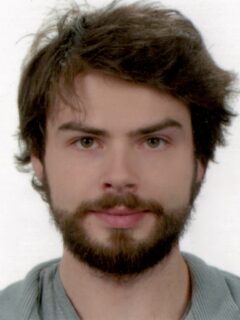
Department of Mechanical Engineering
Lehrstuhl für Kontinuumsmechanik (Schwerpunkt Biomechanik) (LKM, Prof. Budday)
Dr.-Mack-Straße 81
90762 Fürth
- Phone number: +49 911 6507871432
- Email: alexander.greiner@fau.de
- Website: https://www.lkm.tf.fau.eu/
Short Bio
Alexander Greiner, currently a PhD student at the Institute of Continuum Mechanics and Biomechanics (LKM), studied Mechanical Engineering at the FAU, and finished his master’s degree with distinction in 2021. He is currently working within a DACH project in close collaboration with the group of Prof. Gerhard A. Holzapfel at TU Graz. Thereby, he is mainly working on computational models to explore the poro-viscoelastic nature of human brain tissue. Since 2023 he is an associate member of the CRC 1540 “Exploring Brain Mechanics”. Besides, he is interested in tennis, bouldering and climbing.
-
Digitale Zwillinge des menschlichen Körpers für Exascale Supercomputer – dealii-X
(Third Party Funds Group – Sub project)
Overall project: Digitale Zwillinge des menschlichen Körpers für Exascale Supercomputer
Project leader:
Term: 1. January 2025 - 31. March 2027
Acronym: dealii-X
Funding source: BMFTR / Verbundprojekt -
Experiments, modelling and computational simulations to characterize the porous and viscous behaviour of human brain tissue
(Third Party Funds Single)
Project leader: ,
Term: 1. July 2021 - 30. April 2024
Funding source: DFG-Einzelförderung / Sachbeihilfe (EIN-SBH)Computational modelling in biomechanics can provide important insights into the underlying mechanisms of cerebral pathologies that go far beyond the possibilities of traditional methods. The improvement of current prevention and treatment strategies via numerical simulation can only be achieved with a realistic biomechanical model for brain tissue. Understanding and characterizing its short- and long-term biomechanical response, and linking it to its underlying microstructure is essential to develop reliable models. We aim to characterize the mechanical response of brain tissue via the development of a biphasic constitutive model based on a comprehensive set of experimental data. To achieve this goal, the work program is divided into four specific aims: (1) We will devise new experimental set-ups to adequately characterize the visco-porous nature of brain tissue under arbitrary loading conditions. There are very few published studies characterizing the porous effects in brain tissue, all restricted to a single loading mode. Yet, we need to to fit multiple loading conditions simultaneously for the identified model parameters to produce accurate computational results. (2) We will elucidate the relation between the macroscopic mechanical response and the tissue microstructure through microstructural investigations of the tested samples, and, potentially, identify structural model parameters. These investigations are key to confirming our assumptions that porous and viscous phenomena observed in experiments are intrinsically linked to the tissue components, and the interconnectivity of cells. (3) We will develop a poro-viscoelastic model to capture, at the continuum level, the individual effects of the fluid and solid components, and their interaction. The experimental findings in (1) and the structural parameters identified in (2) will enable us to replace phenomenological constitutive equations, previously used to describebrain tissue behaviour, with comprehensive microstructurally motivated material laws. A robust finite element framework will allow for the successful implementation of the proposed model. (4) We will accurately calibrate the model parameters through an inverse material parameter identification scheme and evaluate their physical meaning considering the observed porous and viscous phenomena. The outcome of the project will be a better understanding of the role porous and viscous effects have in the response of brain tissue to mechanical loading. We will have linked the miscrostructure of the tissue to its macroscopic behaviour via experimental and computational investigations. With the resulting calibrated model, we will further explore how structure and mechanical response are linked, as well as demonstrate the potential for application of the proposed model in clinically-relevant problems.
-
Experimente, Modellierung und Computersimulationen zur Charakterisierung des porösen und viskosen Verhaltens von menschlichen Gehirngewebe
(Third Party Funds Single)
Project leader:
Term: 1. July 2021 - 30. April 2024
Funding source: DFG-Einzelförderung / Sachbeihilfe (EIN-SBH) -
Multiscale modeling of nervous tissue: comprehensively linking microstructure, pathology, and mechanics
(FAU Funds)
Project leader:
Term: 1. July 2018 - 30. June 2019
2024
- , , , , , , , , :
Model-driven exploration of poro-viscoelasticity in human brain tissue: be careful with the parameters!
In: Interface Focus 14 (2024)
ISSN: 2042-8901
DOI: 10.1098/rsfs.2024.0026
2023
- , , , , , , , , :
Poro-viscoelastic material parameter identification of brain tissue-mimicking hydrogels
In: Frontiers in Bioengineering and Biotechnology 11 (2023), Article No.: 1143304
ISSN: 2296-4185
DOI: 10.3389/fbioe.2023.1143304
2022
- , , , , :
Tissue-Scale Biomechanical Testing of Brain Tissue for the Calibration of Nonlinear Material Models
In: Current Protocols 2 (2022), p. e381-
ISSN: 2691-1299
DOI: 10.1002/cpz1.381
2021
- , , :
Physical aspects of cortical folding
In: Soft Matter (2021)
ISSN: 1744-683X
DOI: 10.1039/d0sm02209h - , , , , , , :
Poro-Viscoelastic Effects During Biomechanical Testing of Human Brain Tissue
In: Frontiers in Mechanical Engineering 7 (2021), Article No.: 708350
ISSN: 2297-3079
DOI: 10.3389/fmech.2021.708350
Laboratory Training Biomechanics
since 2023